Showing posts with label Math. Show all posts

Thursday, March 2, 2017

Quick Reminders

  Tomorrow will be our test on Physical and Chemical change. A study guide for this was sent home today, but if your child is absent or misplaced their guide I will have it linked below.


  The 3rd 9 weeks math study guide was sent home today. The test will be next week on Wednesday. We will be going over a review packet on Monday and Tuesday, so please help us to get all of the students prepared for these tests!

  The 3rd 9 weeks science study guide will be sent home tomorrow as we did not want it to get confused with the guide for tomorrow's test. The science 9 weeks test will be next Friday and will be reviewing on the days prior.

  Ms. Mason's and Ms. Smith's class will be opening the class store where students can buy prizes using their classroom behavior money. Donations would be greatly appreciated as the students have been working very hard to earn their money. Students may also earn some extra classroom bucks by donating these much needed classroom supplies: paper towels, Clorox wipes, and Expo Spray.

  Thank you and have a wonderful afternoon!!

--- Ms. Mason

Wednesday, February 22, 2017

Perimeter of Regular and Irregular Shapes

Perimeter---the distance around  a figure

Regular shapes-- squares, rectangle, triangles


Irregular Shapes--any shape that does not have equal sides


To find the Perimeter of shapes that provides side lengths...ADD ALL THE SIDE LENGTHS.


4 + 5 + 8 + 3=  20                The perimeter of the shape is 20 inches.


To find the Perimeter of a shape that does not provide side lengths, but does provide units...COUNT THE UNIT SEGMENTS.

UNIT SEGMENTS---THE OUTSIDE OF EACH UNIT


Monday, February 13, 2017

Area and Distributive Property

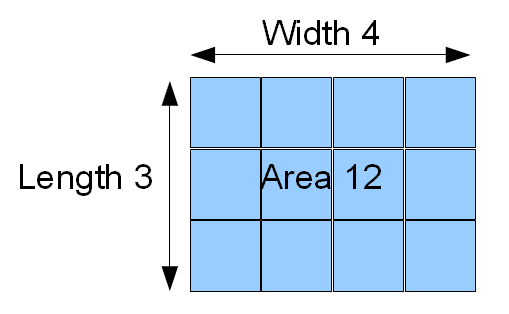
Area-  The surface of a shape or the region of a shape.

Distributive Property--Break up the larger factor/number


Monday, January 30, 2017

Area

We are going over area again in math with our focus being on finding the area in "square units." 

Please help your child to carefully count squares in a shape, and to mark or number each square so they do not lose track.

Please quiz them whenever you have a free moment about whether a unit square should be counted as 0, 1/2, or 1.

A square that has less then half shaded/within the boundary is counted as 0.

A square that is exactly 1/2 shaded/within the boundary is counted as 1/2, and two 1/2 units are counted as 1 unit.

A square that is more than half shaded/within the boundary is counted as 1.

Thank you and have a great week!!

Wednesday, November 16, 2016

Arithmetic Patterns

Pattern:
Things that are arranged following a rule or rules.


Example: there is a pattern in these numbers: 2, 7, 12, 17, 22, ... they follow a rule "start at 2 and add 5 each time"

What is a RULE?

A RULE is a set of directions on how to create a
pattern.

In other words: it tells you what to do with the
pattern.


EX: Rule--Start at 0 and add 2


Pattern: 0, 2, 4, 6, 8, 10, ___, ___, ____

Patterns can be found in addition, subtraction,
multiplication, and division.

  • Addition-- start at 0 and add 3
  • Pattern-- 0, 3, __, ___, ___


  • Subtraction--take 5 away
  • Pattern--- 25, 20, ___, ____, ____


  • Multiplication--- count by 4
  • Pattern--4, 8, ___, ___,____


  • Division--Divide by 2
  • Pattern-- 40, 20, ___,____


Monday, November 7, 2016

Area of a Shape

What is Area?

  • The size of a surface.


  • The amount of space inside the boundary of a flat (2-dimensional) object such as a square, rectangle, triangle or circle. 


Area by Counting Squares

  • To find the area of a shape you can count the units/squares it takes to create the shape.


The rectangle has an area of 16

If each square was 1 cm on a side, then the area would be 16 cm2 (16 square cm).


Approximate Area by Counting Squares

  • Sometimes the squares don't match the shape exactly, but we can get an "approximate" answer.

One way is:


more than half a square counts as 1
less than half a square counts as 0
if exactly half a square count as 1/2


The Area of a square/rectangle can also be found by
using a formula:

Base x Height = Area


Tuesday, November 1, 2016

Multiply by Multiples of 10

Multiple:
A multiple of a number is the product or answer of that number and any other whole number.

(In other words)
A multiple of a number is when you multiply a set number by other numbers.
EX: 2 x 1 = 2 2 x 2 = 4 2 x 3 = 6
      2 x 4 = 8 2 x 5 = 10 2 x 6 = 12
The multiples of 2 are the answers:
2, 4, 6, 8, 10, and 12

Multiplying with base ten blocks: 

Try these!
30 x 4=

70 x 4=

40 x 5=


How to multiply by multiples of 10:

 20       Step 1: Count the zeros (0)
x 6       Step 2: Put that many 0s in your 
----             answer
 120      Step 3: Multiply the remaining                           factors

Try these!
70 x 4=

30 x 8=

90 x 7=

80 x 3=

60 x 5= 

20 x 6= 

Monday, October 17, 2016

Properties of Multiplication

  
This week in math we will be learning about the different properties of multiplication.  The definition for each property was provided in class.  This is the notes taken for this week.

Commutative Property: The factors can be multiplied in any order and the product will stay the same.
EX: 4 x 5 = 20 5 x 4 = 20 So, 4 x 5 = 5 x 4

Associative Property: The way in which three numbers are grouped when they are being multiplied doesn't change the product.
EX: 2 (4 x 5)= 40 4 (5 x 2)= 40 So, 2 (4 x 5)= 4 (5 x 2)

Distributive Property: Multiply a sum by multiplying each added separately and then add the products.

In other words: BREAK IT UP (Break the second factor up into smaller digits.)

EX: 4 x 5 = 20 4 x 2 =8 4 x 3 = 12 8 + 12 = 20


The Commutative Property of Multiplication:

a x b = b x a

Where a and b are any real numbers.

This rule just says that, when you are doing multiplication, it doesn't matter which order the numbers are in. You can multiply a and b OR you can multiply b and a ... and you'll get the same answer.


NOTE: This does not work with division!

Distributive Property of Multiplication:


Associative Property of Multiplication:


Thursday, October 13, 2016

Quick Reminder

Just wanted to post a quick reminder about the Unknown Numbers test that we are having tomorrow. 

We will be starting the Nervous System tomorrow, and the notes will be posted for those as well. There will be a test on the Digestive and Nervous systems on Wednesday the 19th. 

Have a wonderful afternoon and thanks for visiting! If you have any questions, comments, or concerns feel free to send an email or leave a friendly comment below! 

Wednesday, October 12, 2016

Fact Families

Today we touched on Fact families which will be discussed in more depth next week. Fact families are wonderful for showing how multiplication and division are related. They are simply all of the possible division and multiplication equations that are possible with a specific set of numbers.

For example: The fact family for the numbers 7, 3, and 21 is: 3×7=21   7×3=21   21÷7=3   21÷3=7


We have already gone over changing to the inverse (or opposite) problem many times, so the students know how to go from multiplication to division and vice versa.


The purpose of this is to show how multiplication and division are related which also helps them to identify and solve for unknown numbers.


If you have any comments, questions, or concerns feel free to email me or leave a friendly comment below.


Thanks for visiting!

Tuesday, October 11, 2016

Unknown Numbers

Unknown Numbers

Today we went began going over unknown numbers once again and in more detail.

An unknown number is like(21÷n=3) (5 x H=10) (R÷8=2) (9x6=k)

We are teaching them to know whether or not they need to multiply or divide by looking at what numbers they have.

If they have the dividend(the 21 in the example above) or the product (the 10 in the above example), then they have to divide. (21÷3=n) (10÷5=H)

If they have divisor (the 8) and the quotient (the 2), or both factors (the 9 and 6) then they would multiply to find the answer. (8x2=R) (9x6=k)

On my each of my walls I have added two artifacts for them to look out throughout the lesson. These look like the following:


Dividend--->Divisor/Quotient--->Divide

Factor--->Product--->Divide

Divisor--->Quotient--->Multiply

Factor--->Factor-->Multiply
And:


21 ÷    3 =   7
^                  ^            ^
Dividend           Divisor       Quotient

3 x   7 = 21
^            ^          ^
Factor         Factor      Product


If you have any questions, concerns, or ideas, please feel free to email me or leave a friendly comment below! Thank you for viewing!