Perimeter---the distance around a figure
Regular shapes-- squares, rectangle, triangles
Irregular Shapes--any shape that does not have equal sides
To find the Perimeter of shapes that provides side lengths...ADD ALL THE SIDE LENGTHS.
4 + 5 + 8 + 3= 20 The perimeter of the shape is 20 inches.
To find the Perimeter of a shape that does not provide side lengths, but does provide units...COUNT THE UNIT SEGMENTS.
UNIT SEGMENTS---THE OUTSIDE OF EACH UNIT
We are going over area again in math with our focus being on finding the area in "square units."
Please help your child to carefully count squares in a shape, and to mark or number each square so they do not lose track.
Please quiz them whenever you have a free moment about whether a unit square should be counted as 0, 1/2, or 1.
A square that has less then half shaded/within the boundary is counted as 0.
A square that is exactly 1/2 shaded/within the boundary is counted as 1/2, and two 1/2 units are counted as 1 unit.
A square that is more than half shaded/within the boundary is counted as 1.
Thank you and have a great week!!
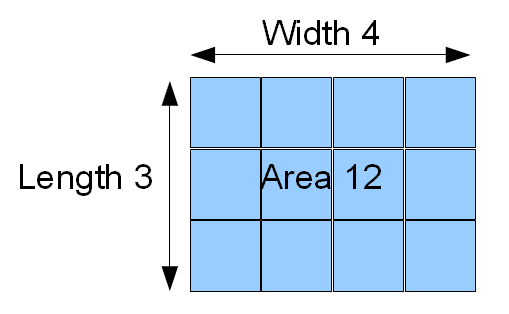
What is Area?
- The amount of space inside the boundary of a flat (2-dimensional) object such as a square, rectangle, triangle or circle.
Area by Counting Squares
- To find the area of a shape you can count the units/squares it takes to create the shape.
The rectangle has an area of 16
If each square was 1 cm on a side, then the area would be 16 cm2 (16 square cm).
Approximate Area by Counting Squares
- Sometimes the squares don't match the shape exactly, but we can get an "approximate" answer.
One way is:
more than half a square counts as 1
less than half a square counts as 0
if exactly half a square count as 1/2
The Area of a square/rectangle can also be found by
using a formula:
Base x Height = Area